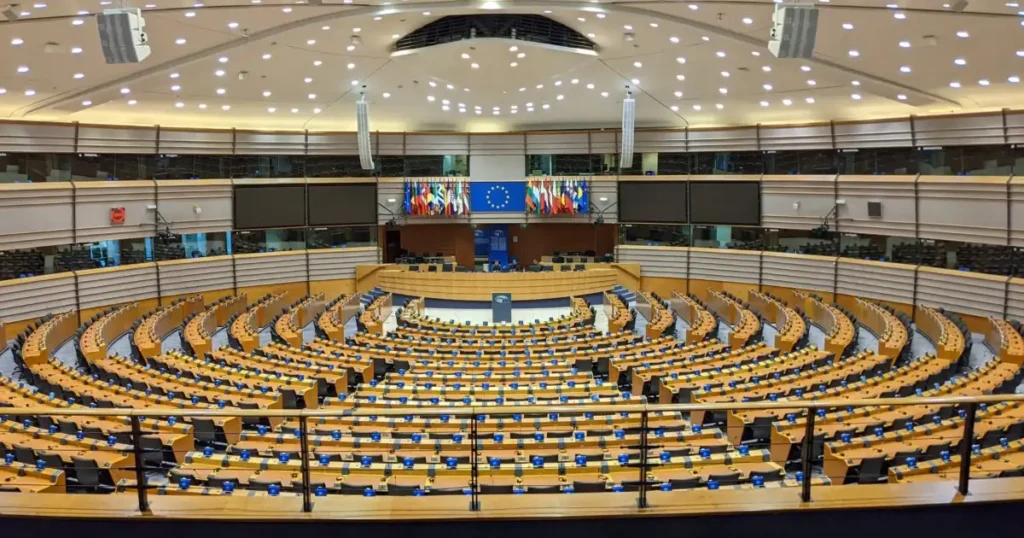
On 20 October 2026 the European Parliament adopted its first-reading position on the regulation on the enforcement of passenger rights. The text amends five passenger rights regulations at once, covering air, rail, bus and coach, and sea and inland waterway travel. For air tickets, one of the most important changes concerns passengers who booked through a travel agent or an online booking platform. It is not binding law yet: the Council still has to act, and the regulation has to be published.
What did Parliament vote for on 20 October?
Parliament adopted its position by 652 votes to 2, with 8 abstentions (summary by the EP Legislative Observatory). The European Commission tabled the proposal on 29 November 2023 (COM(2023)0753). The Committee on Transport and Tourism (TRAN) approved the text agreed with the Council on 2 September 2026, and the plenary has now voted on it (text adopted, T10-0347/2026).
The regulations amended are 261/2004 (air passenger rights), 1107/2006 (disabled persons and persons with reduced mobility travelling by air), 1177/2010 (sea and inland waterway passengers), 181/2011 (bus and coach) and (EU) 2021/782 (rail).
- 29 Nov 2023 Commission proposal
- 24 Jun 2025 Vote in the TRAN committee
- 2 Sep 2026 TRAN approves the text agreed with the Council
- 20 Oct 2026 Parliament’s first-reading position (652 in favour, 2 against, 8 abstentions)
- Still to come The Council’s first-reading position, then publication in the Official Journal
- 23 Oct 2027 Start of application (according to the adopted text)
Figure 1. The path of the enforcement package. Source: European Parliament Legislative Observatory (2023/0437(COD), status on 5 November 2026), Article 6 of the adopted text.
Who refunds the ticket when it was booked through an intermediary?
After a cancellation, passengers were already entitled to a refund of the ticket price within seven days. With bookings made through an intermediary, however, it was often unclear whether the airline or the agent should pay. The adopted text splits this into three situations.
- The intermediary is not involved in the refund, or did not pay the airline for the ticket from its own account: the airline pays the passenger directly. The deadline is seven calendar days from the passenger sending proof of the full ticket price and any intermediation fee, together with their payment details.
- The intermediary paid for the ticket from its own account: the airline refunds the ticket price to the intermediary within seven calendar days. The seven days start on the day the passenger chooses a refund. The intermediary then pays the passenger within a further seven calendar days at the latest, using the payment method used for the booking, and provides the transaction number of the bank transfer.
- The refund stalls at the intermediary: if, within 14 calendar days of the passenger choosing a refund, the airline has not received confirmation of payment from the intermediary, it contacts the passenger at the latest on the following day. It then pays the passenger itself within seven calendar days of receiving the details.
Figure 2. How refunds work for bookings made through an intermediary. Source: text adopted by the European Parliament on 20 October 2026 (T10-0347/2026).
Before the passenger finalises the booking, the intermediary must say whether the airline agrees to process refunds through it, and how the refund process works. At the same point it must state any intermediation, administrative, service or cancellation fee, and the passenger’s right to get the intermediation fee back in full. A refund processed through the intermediary must be free of charge for the passenger.
Two deviations are possible. An intermediary that is an autonomous micro-enterprise may keep a specified amount of its intermediation fee if it told the passenger so clearly and prominently at the start of the booking. The airline may also agree a different procedure with the intermediary, provided the passenger gets an equivalent level of protection, in particular on the refund of the intermediation fee and on payment deadlines. The intermediary refund rules do not apply to tickets booked as part of a package (package travel).
What changes for claims and complaints?
The Commission will adopt an implementing act establishing a common form for reimbursement and compensation requests, available in all official EU languages. According to the Legislative Observatory summary, the form will be available for all modes of transport. Airlines and intermediaries may not reject a request because the passenger did not use the airline’s form or the common form, or because the form was not sent electronically. Passengers may also submit their request in the language in which the booking was made.
Each Member State designates one or more national enforcement bodies and a body for passenger complaints. The complaints body must acknowledge receipt of a complaint within 14 calendar days. National enforcement bodies may carry out audits, inspections, interviews and the examination of documents. Where an airline refuses compensation by citing extraordinary circumstances, it has to back up that claim with evidence at the request of the national enforcement body. When such circumstances actually exempt an airline is the subject of our article on the Court of Justice ruling of 8 October.
Disabled persons and persons with reduced mobility also get a new right. Where an airline requires them to travel with a companion but does not provide the assistance needed, they may travel with a person of their choice, who travels free of charge and is seated next to them.
When does this become binding law?
On 5 November 2026 the EP Legislative Observatory shows the procedure awaiting the Council’s first-reading position (2023/0437(COD)). Publication in the Official Journal of the European Union follows. According to the adopted text, the regulation enters into force on the twentieth day following its publication and applies from 23 October 2027.
Regulation (EU) 2026/2202, which amends EU261 and entered into force on 22 October 2026, also applies from that same day. If the Council adopts the text unchanged, the two sets of rules will take effect together. Regulation 2026/2202 brings the conditions for compensation and the airlines’ deadlines: where a passenger may be entitled to compensation, the airline must inform them of that right within 96 hours of the end of the journey, and it must pay or explain a refusal within 30 calendar days of receiving the claim. The enforcement package brings the intermediary refund rules, the common claim form and closer oversight by the authorities. Until then, the current rules apply.
In our article on the record summer we still described the package as a provisional agreement; we will update its status there as well.
This article is general information, not legal advice. The binding text is the regulation as published in the Official Journal.